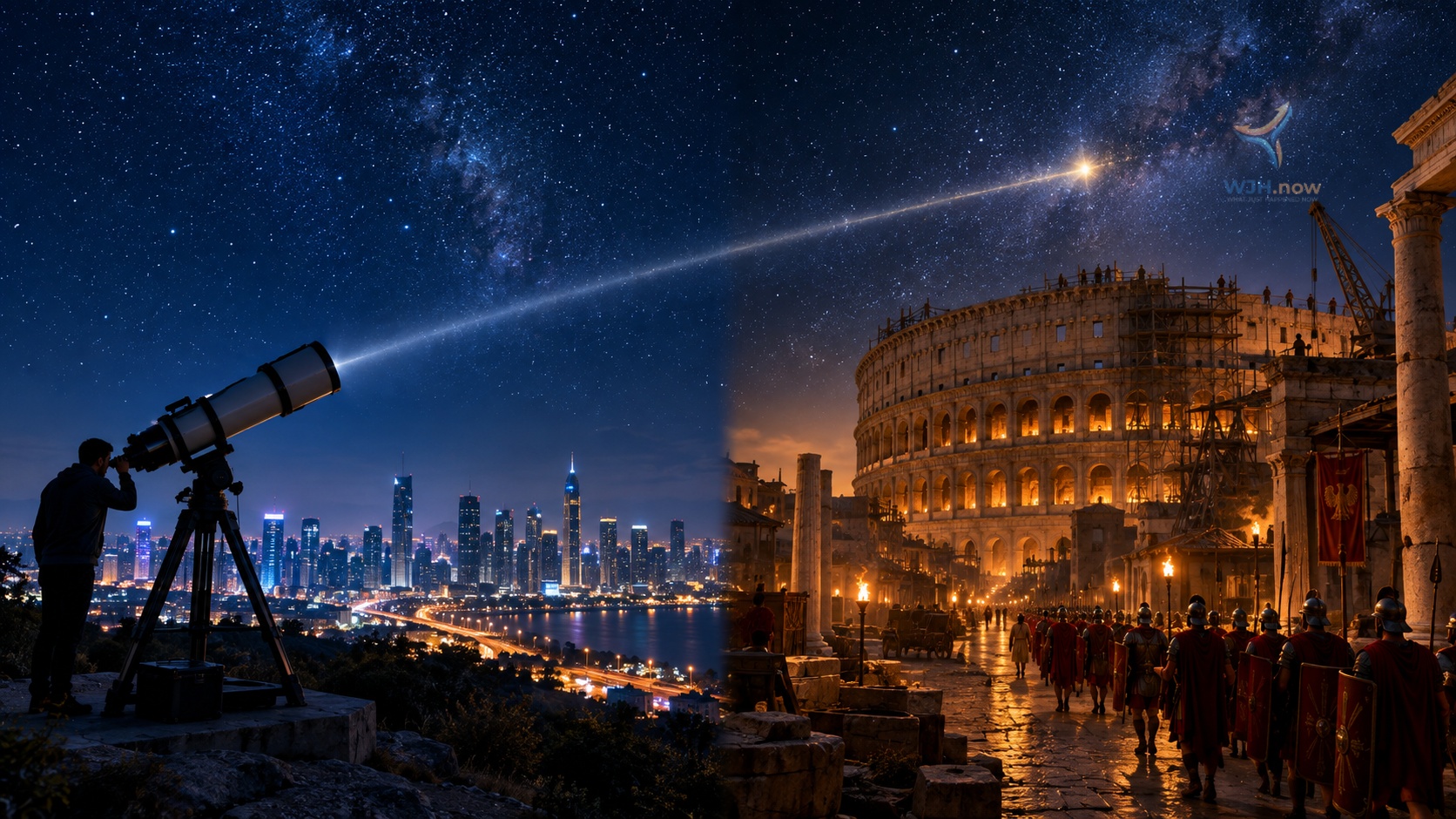
Every clear night you look up at the stars and feel like you’re seeing them as they are right now. You’re not, because you’re actually seeing old news.
#That one fact led me to a strange question I can’t stop chewing on. If someone out there, two thousand light-years away, pointed a powerful enough telescope at Earth, what would they actually see? Not us, and not today, since they’d see the Roman Empire instead.
Light feels instant when you flip a switch and the room is just lit, but light has a speed limit of about 300,000 kilometers per second, and space is way bigger than that. So everything you look at is a little in the past: the Moon is about 1.3 seconds behind, the Sun is about 8 minutes behind, and a star two thousand light-years away shows you what it looked like two
thousand years ago. If it blew up tonight, we wouldn’t find out until around the year 4026. The stars aren’t where they look, meaning you’re seeing where they were. Yet, this cosmic delay also means that looking outward is essentially looking backward in time, which naturally brings us to how our own planet writes its history across the cosmos day by day.
Now if you flip it around, sunlight bounces off our oceans, our cities and our faces all the time, and that light streams out into space and keeps going. The light that glinted off a Roman soldier’s armor two thousand years ago has been traveling ever since, and it’s only now reaching a planet two thousand light-years away. We’re broadcasting our whole history, and none of us signed up for that. I still remember when this first hit me outside on a clear night, staring at a bright star when someone told me the light I was seeing had left that star before I was even born. Maybe even before my
grandparents were born, which made me just go quiet. It wasn’t the math that bothered me, but rather the thought that the star I am seeing might not even be there anymore—and it still looked perfectly fine from here as if it’s the present. Still, catching that faint glow from across the cosmos isn’t as simple as pointing an ordinary backyard lens at our blue dot.
Because seeing something human-sized from that distance takes an absurd telescope. By my own rough math, and I’m no astronomer, you’d need a mirror something like 80 times wider than the distance from Earth to the Sun. Call it approximately that, give or take a lot, though a single mirror that big would collapse under its own gravity. Someone with that kind of tech wouldn’t build one, and they’d probably link thousands of smaller telescopes across their solar system and make them work as one giant eye called interferometry, which we already do a small version of on Earth. Or they could use a star as a lens, since Einstein predicted that gravity bends light and a solar eclipse in 1919 backed him up. For our Sun, the lens effect kicks in at roughly 550 times the Earth-Sun distance, way out past Neptune. People have seriously proposed sending a probe out there, though whether anyone has built one somewhere else, I have no idea. Depending on where those hypothetical observers ended up setting up their gear, they would tune into entirely different chapters of human civilization.
If they are 2,000 light-years away, they get the Pax Romana with Rome at its peak. About 1,946 light-years out, they catch the Colosseum opening in 80 AD with a packed crowd, and if they aim at China, they get the Han Dynasty and the early Silk Road caravans. Every distance is a different channel, so the universe is streaming every era of Earth at once. This multi-layered broadcast of history leads directly into even deeper questions about how time itself is perceived, both by distant alien viewers and by our own minds.
If everything we see is old light, then “right now” is never really right now. Researchers who study perception say much the same about our own brains, because signals take time to travel and get processed, so the present we feel is already a fraction of a second old. Relativity adds an even bigger twist, as physicist Jim Al-Khalili points out that two observers moving differently can disagree about which of two events happened first, so there’s no single “now” shared by the whole universe. So here’s my wondering, and it’s only that: what if this moment, the one we’re so sure is the present, is itself a kind of borrowed light, a replay of something that happened long ago somewhere else? Nobody has tested that, and I’m not claiming it.
The closest real physics I know of is called the holographic principle. You know the shiny hologram sticker on a bank card that looks 3D like it has depth, but it’s printed on a flat surface? In the 1990s, two physicists named Gerard ’t Hooft and Leonard Susskind started asking whether the universe might work a bit like that sticker. The idea grew out of black holes, because whatever falls into one may not vanish, and its information may be recorded on the black hole’s outer surface instead. Stretch that further, and maybe everything that makes up our 3D world is stored on a flat surface far away, the way the sticker stores its depth. To be clear, that’s a theory, not a proven fact, and nobody has shown that our universe is a hologram since the idea mostly lives in the math of string theory and quantum gravity. It also doesn’t mean life is fake, but it only suggests that what we experience might be a kind of display of something deeper. Which brings me back to my wondering. If what we see is a display of something else, is our “now” the original, or a playback? I can’t prove it either way, but every time I look up, I can’t quite shake the thought.
We started with the night sky, and the same idea has run through every stop since. Looking far away means looking back in time. The stars above you are history, and the light we send out is history too, headed toward someone we’ll never meet. The part that gets me is the delay. If they spotted us and waved back, their message would take another two thousand years to reach us, so one hello-and-reply costs four thousand years. We’d be answering people who watched Rome in real time. And if my wondering is even a little right, maybe this very moment is old news to somebody too.