Your Brain Quietly Cleans It Up
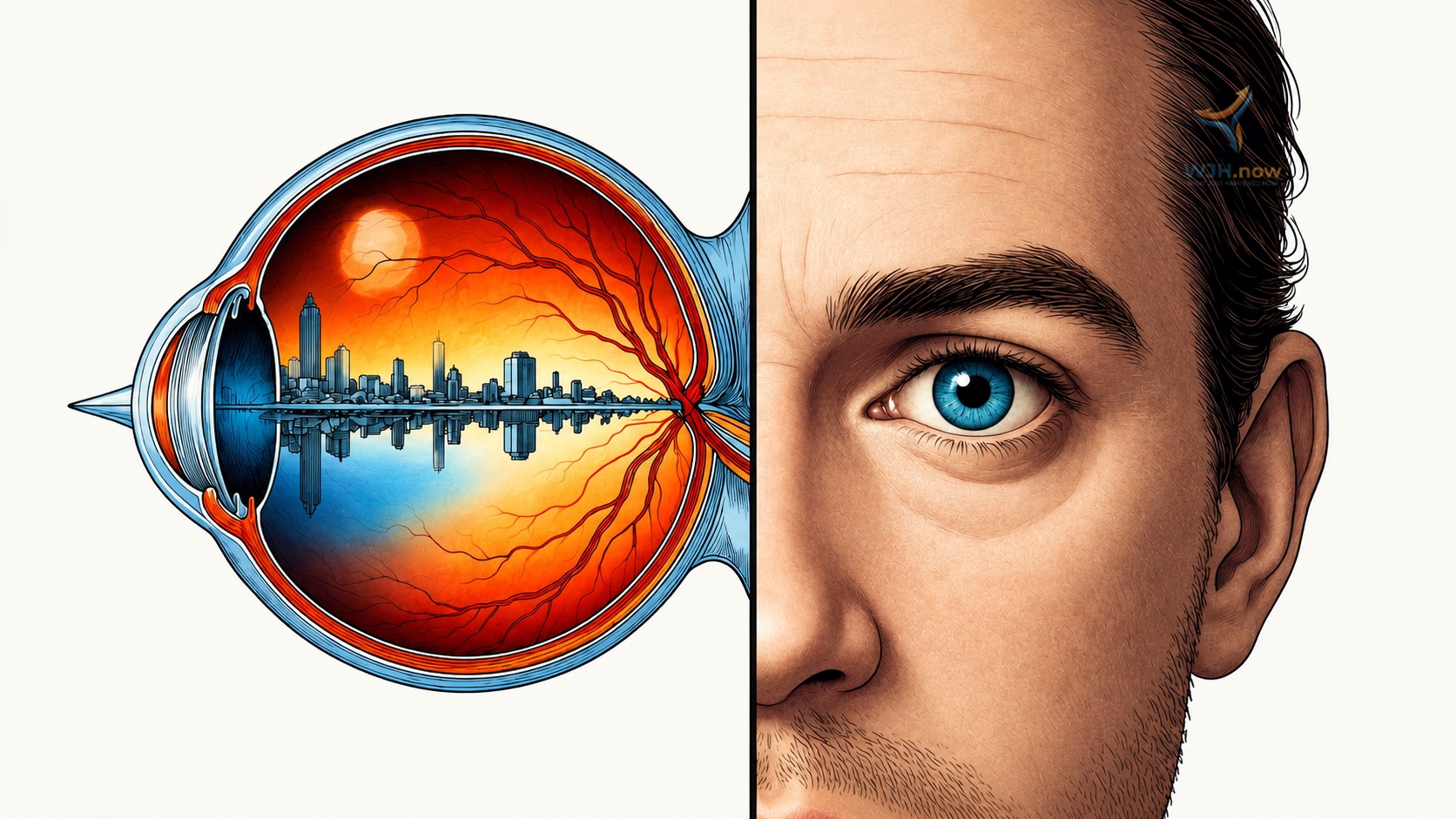
The retina doesn’t know or care that the picture’s flipped.** It just converts light into electrical signals and fires them down the optic nerve toward the brain. Your visual cortex receives this upside-down data, and somewhere in there, it gets sorted out. You never consciously see the inverted version. Happens so fast, so automatically, it feels like the world was never flipped in the first place.
Curious about this? We also covered “Did you know? Boiling in space is backwards” here
This is the part that actually bugs me about how it usually gets explained online.**
The brain doesn’t have a little internal screen, and it isn’t literally spinning your vision right-side up like rotating a photo on your phone. Nothing gets physically “flipped.” What actually happens is your brain maps sensory input to motor output. Over time it learns that light hitting the bottom of your retina corresponds to something high up in the real world, and it wires your muscles and your sense of space around that mapping. You’re not seeing an upright picture, your brain is building a 3D map good enough to keep you from walking into a wall.
The Goggles Experiment
Scientists actually tested this, decades ago now. George Stratton, back in the 1890s, wore special goggles that flipped his entire visual field upside down. At first, walking and reaching for things fell apart completely. Give it a few days though, and the brain adapted. The world started to feel normal again.. even with the goggles still flipping every single thing he saw.
It’s a bit like getting off a giant wheel or a spinning ride, and the ground still feels like it’s moving for a second after you step off. Your balance system needs a moment to catch up with reality. The goggles experiment is that same lag, just stretched out over days instead of seconds.
And yet again, this is the part that actually bugs me about how it usually gets explained online.
Did the world actually flip back to looking right-side-up for him? Cognitive scientists genuinely argue about this one. In the real experiments, subjects adapted well enough to move through their days normally. But their raw visual perception probably didn’t magically snap back upright. What adapted was the connection between what they saw and what they did about it, their visuo-motor mapping. They learned to instinctively reach “down” for something that visually still appeared “up.” Navigating the upside-down world started to feel natural, even though, technically, they may have still been seeing it upside down the whole time.
Take the goggles off, and the real world looks flipped again for a while.. until the brain re-adjusts, again.
Why This Is Actually Interesting
It’s a little creepy honestly, thinking about how completely the brain adapts to something like this. Your brain isn’t loyal to one fixed way of seeing. It’s continuously rewiring itself around whatever input it gets. Scientists have a name for it: neuroplasticity, the brain’s ability to keep changing and adapting throughout your life.
In the goggle experiments, the brain didn’t just put up with an upside-down world, it actively rebuilt its map of reality so the flip felt normal. That’s the same flexibility that lets people recover from injuries, pick up new skills, or adjust to places they’ve never been.
Your brain isn’t handing you a photograph of the world. It’s building a working model of it, fast enough that you never get to notice.
The Takeaway
Most of what you “see” isn’t a raw recording. It’s a processed, corrected, edited version, assembled by your brain on the fly.
That upside-down imagery hitting your retina? Don’t bother thinking about it too hard, that’s just the raw data dump. What you actually get to see is the cleaned-up version your brain decides to show you.
So next time you look around.. the picture arriving at the back of your eyes is upside down, right now, as you read this. Your brain just deals with it quietly, without asking your permission.